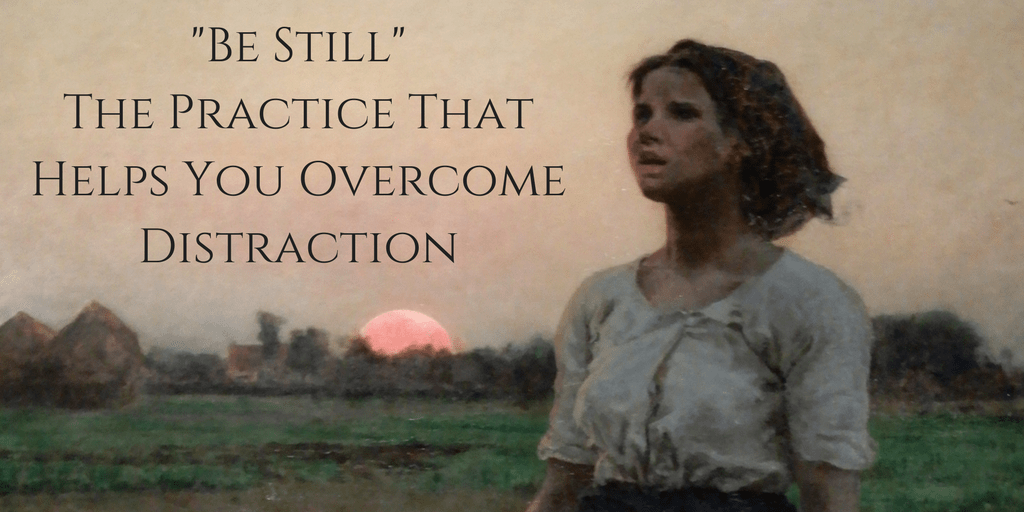
“All of humanity’s problems stem from man’s inability to sit quietly in a room alone.” Blaise Pascal
Do you struggle with distractibility? I know I sure do. The human brain is constantly flitting from one thing to the next. We’re bombarded by stimuli; every day, we receive thousands of messages from people clamoring for our attention. This onslaught breaks up our focus and fuels distractibility. The end results are depressing: blindness to areas for improvement, depletion of energy, and hinderance of spiritual growth.
There’s one great inoculation against distractibility: the skill of paying deep attention to this moment.
Sitting still is one of the best practices to build that skill. It’s like doing deadlifts or bench presses for your mind. Give it a try. Turn off all the electronic devices: TV, laptop, cell phone, etc. Find a quiet comfortable place, and simply sit. Set your timer for fifteen minutes and do nothing but sit. That’s it, just sit.
It’ll drive you crazy.
When I first tried to do this, I was suddenly aware of a careening freight train of thoughts pulling me away from the moment: worries, things on the to do list, people you forgot to call, cravings, guilt, boredom, etc. My mind was anywhere but still and in the moment. How in the world could I pay attention to the moment when my mind was bouncing all over the place. No wonder I have problems focusing.
This is where scripture helps.
Psalm 46 teaches us about paying attention. The big idea of the psalm is that God is with us, even in the times of storm and stress and trouble. God is ever present (v1), God is with us (v 7 and 11)
And then, right near the end, we get this little instruction: “Be still and know that I am God, I will be exalted among the nations, I will be exalted in the earth.” (Psalm 46:10)
For the Christian, part of the point of learning to pay attention is to know in an experiential way that God is with us here in this moment. You can, if you want, dismiss this as mysticism or sentimentalism. However I’ll wager that most Christians have at some point had a powerful experience of the presence of the Lord and have found that experience to be quite comforting.
So when I sit still, and the thoughts begin to pile on, I acknowledge the thought that’s right there in the forefront of my mind. And then I answer it with the thought “Be still and know that I am God.”
- That worry that comes into my mind? That’s a future worry, and God holds the future. In this moment, I’m sitting securely in God’s hands. “Be still and know that I am God.”
- That person that betrayed me? I’ve not been destroyed. God has me safe in this moment. I commit that person to God’s care and pray for their blessing. But for now “Be still and know that I am God.”
- That regret from the past? God has forgiven all my wrongs and washed them away. Perhaps God will show me where I can make amends. But for now “Be still and know that I am God.”
- All those things that need to be done? None of them are so critical that lives hang in the balance. The time for prioritizing and action will be later. The time for sitting with God is now. So “Be still and know that I am God.”
I find that when I regularly practice stillness, I am calmer, more focused, and able to get a lot more work done. I’m happier, more grateful, and more attentive to other disciplines that promote my wellbeing and my spiritual growth.
A few things to note:
1) Stillness does not take the place of regular Bible reading and reflection. Rather, it’s a separate habit. Bible reading helps re-shape your thinking. Stillness helps you focus your thinking. They should complement one another.
2) If you have experienced massive emotional trauma or if you struggle with mental health issues, please do not practice stillness without the guidance of someone trained in mental health. Just as you need a physical therapist after recovering from a bodily injury or illness, so you need a brain therapist after recovering from a mental trauma or illness. Stillness is not a cure-all for the traumatized; it is an exercise that is a part of a life of wellbeing.
Have you practiced stillness? Tell me about your experiences in the comments below.
Think a friend might benefit from stillness? Please share this post with them or share it on social media.
Now go be a blessing
RS



 Horizons of the Possible
Leave a comment